TL;DR
- Keep the task, its owner and its status where the whole team can see them, and attach the evidence the next person will need.
- When work stalls, check whether it is missing information that anyone can supply or a decision that only one person can make.
- A sign-off should name the version and say what it can be used for, so nobody has to reread the conversation to find out.
An AI agent marks a task done. Then a person has to use the result, and the questions start. Is this the latest version? Has anyone checked it? Can it go to a client, or only to the team? “Done” tells you the agent has stopped. It doesn’t tell you what the work is ready for. Decide that before you assign the task, and the next person can act on the result instead of asking around.
Why is the handoff getting attention now?
On Nov 18, 2026, Vercel introduced Board, an experimental tool that agents use to coordinate work. Its launch example ends with an agent completing its task with the message “Can I get a review?” The agent is done. The team is not.
Developer Matt Pocock responded with five things he would want from a tool like it: asking a question mid-task, leaving a message for an agent that is offline, scheduling repeat work, working across different agent tools and calling a workflow by name. Each one is really a handoff question, and every team that puts agents to work has to answer them, whatever tools it uses.
What does the team need to see?
A shared task record and the agent doing the work do different jobs. The agent needs enough context to do the task. The team needs one place to see who owns it and how far along it is. The next person needs more than either: the current version, the evidence behind it and any question that is still open. Keep those where both the owner and the next person can find them.
A simple test tells you what belongs in the shared record. Ask what a colleague would need in order to pick the work up tomorrow without calling you. Whatever that is, put it there.
When does a handoff need a decision?
Work stalls for two different reasons, and they need different handoffs. Sometimes a piece of information is missing. Anyone who has it can supply it, so pass on where the work stands and exactly what you need. Sometimes a decision is missing: the scope has to change, or someone has to choose between two readings of the brief. That goes to the person with the authority to decide. In the meantime, the rest of the work can carry on, as long as it doesn’t depend on the answer.
Give the reviewer something they can actually decide. Send the exact version, show what its conclusions rest on and point to where you need their judgment. If they send the work back, record the reason where whoever revises it, person or agent, will see it. A specific reason tells them what to fix and tells the next reviewer what to check.
What does a sign-off allow?
Finance teams call it maker-checker: one person prepares the work and another reviews it independently. The same split works for agents. The agent prepares, and a person with the right authority decides whether the result is fit for its intended use. The Basel Committee’s operational risk guidance sets out the related principles of segregation of duties and clear approval authority.
Record who decided, which version they saw and what use they approved. A result cleared for an internal discussion has not been cleared to leave the company. If the audience changes, the planned action changes or the evidence shifts materially, take it back to the person who can decide.
How does AMBR handle those five ideas?
At AMBR, we run this on two tools of our own. Nex is the shared workspace where each task is a card with an owner, a deadline and a status. Buddy is a colleague’s personal agent: it works with that colleague’s own files and accounts, and a person signs off on what it produces. How We Run AMBR on AI Agents describes the setup in more detail. The image below sets each of the five ideas beside how that setup handles it.
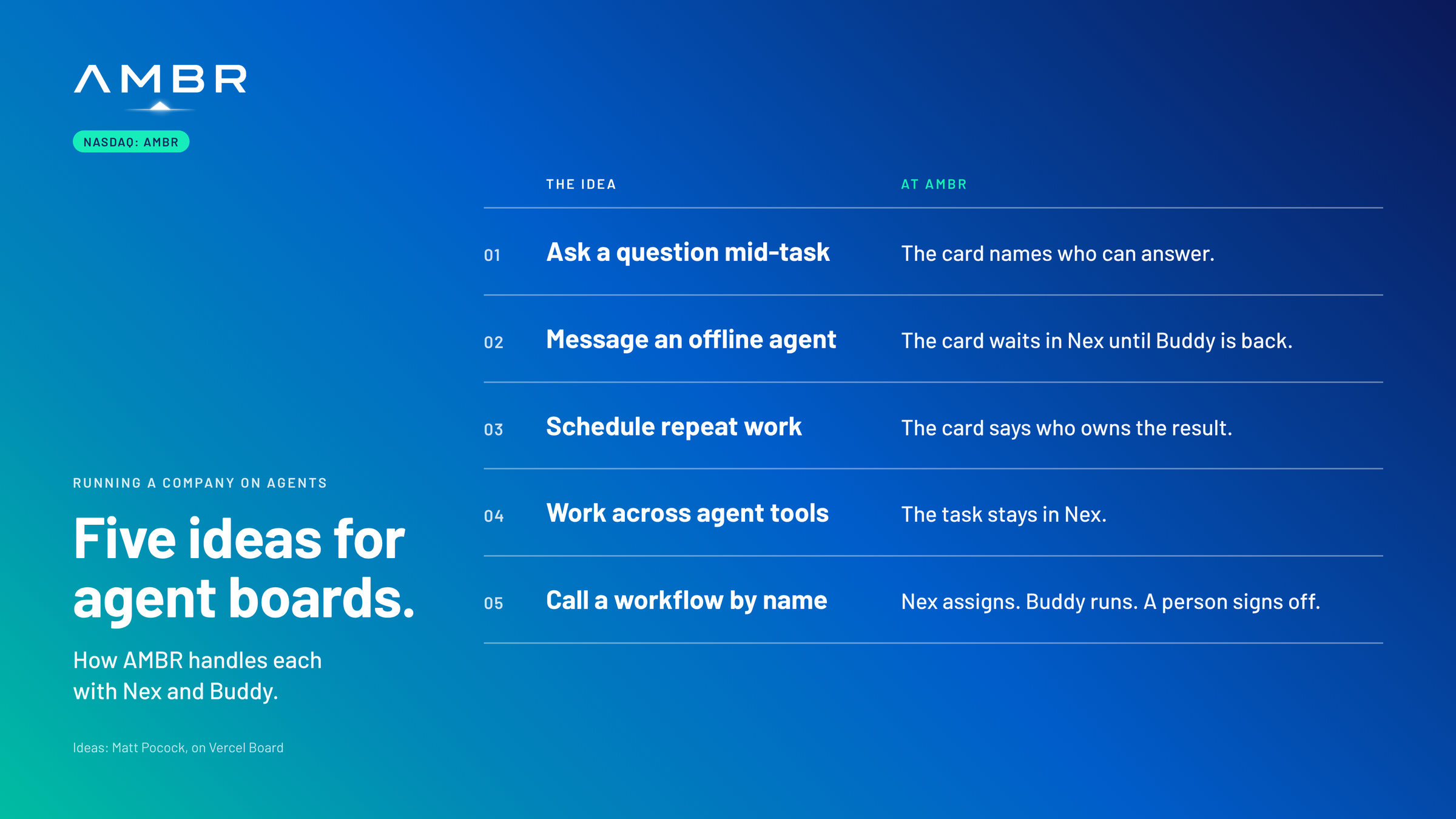
In all five cases the answer comes back to the same two things: a card the whole team can see, and a named owner.
Test your next handoff
Pick a handoff your team already makes and give it to a colleague who missed the original discussion. Ask them to find the current result, name any decision that is still open and say what the result can be used for. If the work was sent back for revision, check that they can see why. The first thing they have to ask you is the thing your handoff is missing.